


Barber chair vs styling chair: what's the difference?
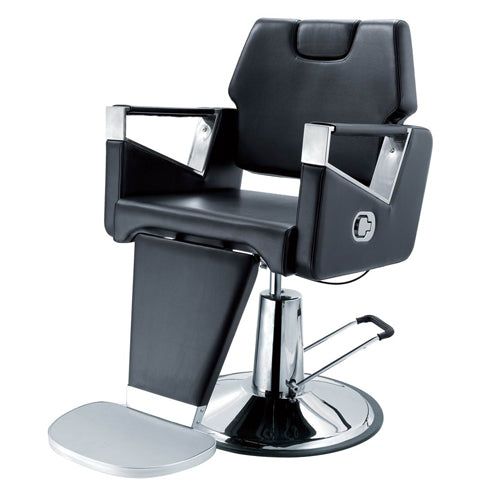
A barber chair is built for clipper cuts, beard work and shaves: it usually has a headrest, a backrest that reclines and a built-in footrest, on a heavy hydraulic base. A styling chair is built for cutting, colouring and styling in a salon: it pumps up and down and swivels, but usually has a fixed upright back, no headrest and no footrest of its own. Barber chairs are usually bigger and heavier, while styling chairs are more compact and easier to fit into a busy floor. If you offer shaves or beard trims, choose a barber chair; for most salon work, a styling chair is the practical choice.
Barber chair vs styling chair at a glance
| Feature | Barber chair | Styling chair |
|---|---|---|
| Headrest | Usually fitted, often adjustable or removable | Usually none, though some multi-purpose chairs have one |
| Backrest | Usually reclines, for shaves and beard work | Usually fixed upright |
| Footrest | Usually built in | Usually separate, on the styling unit or freestanding |
| Hydraulic pump | Raises and lowers a heavier chair; some are heavy duty | Raises and lowers the seat |
| Rotation | Swivels; some lock in place | Swivels; some lock in place |
| Base | Usually heavy, to keep the chair stable when reclined | Five-star, round or square flat base |
| Size | Usually larger and heavier | Usually more compact and lighter |
| Suits | Barbering, fades, beard trims and hot towel shaves | Cutting, colouring, blow-drying and styling |
Headrest
A headrest supports the client's head as the chair reclines, which is what makes wet shaves and close beard work comfortable. On many barber chairs it adjusts or comes off, so it isn't in the way when you work on the nape: the Belmont GT Sportsman has a removable headrest, and the Barburys Dylan has one that adjusts for height. Most styling chairs have no headrest, although multi-purpose chairs such as the Belmont Cadilla M do.
Recline
A reclining back lets the client lie back for a shave, a hot towel or a beard trim, as on the Crewe Orlando Antigua reclining barber chair. Some, such as the Belmont Apollo 2, have a synchronised recline. Styling chairs usually stay upright. If you need a chair that reclines for brows, lashes or make-up rather than hair, a cosmetic chair such as the REM Macy, with a reclining backrest and adjustable headrest, is made for that.
Footrest
Barber chairs usually have a footrest built into the chair. Styling chairs usually don't, so clients rest their feet on a footrest fixed to the styling unit or on a freestanding one, such as the Crewe Orlando Waterford footrest, which is made for salon and barber chairs. A few styling chairs include one, such as the Belmont Cadilla, which has a footrest with a stopper.
Hydraulic pump, rotation and base
Both types sit on a hydraulic pump, worked with a foot pedal, so you can raise and lower each client to a comfortable working height. Barber chairs are heavier, so they generally need sturdier pumps and bases: the REM Voyager, for example, is built with heavy-duty hydraulics.
Most chairs swivel, and some let you lock the pump or the rotation so the chair stays put while you work. The Crewe Orlando Bermuda styling chair has a locking hydraulic pump, and the Belmont GT Sportsman barber chair has 360° lockable rotation.
Styling chair bases come in five-star, round and square flat styles, and flat bases are simple to sweep around. On some ranges you can change the base or pump: REM, for example, offers a square Quadra base and a black base and pump as upgrades for its salon chairs.
Height range
Bringing the client to the right height helps you work without stooping. HSE's guidance on reducing awkward postures recommends adjustable working heights wherever possible, because people's elbow heights differ, and in a salon the chair is how you adjust the height. Check the listed range against your own working height and your clients: the Crewe Orlando Antigua styling chair, for example, adjusts from 47 to 57cm. For children, a booster seat adds height; the Crewe Orlando children's booster seat adds 20cm.
Space and layout
Barber chairs take up more floor space than most styling chairs, and a reclining back needs clear space behind it. Before you order, measure each station and allow for the chair fully reclined, room to walk all the way round it, and the client's legs on the footrest. Styling chairs are more compact: the Crewe Orlando Antigua styling chair is listed at 63cm wide and 60cm deep. The basin area needs its own backwash units, so you don't need styling chairs there.
Upholstery and cleaning
Chairs get wiped down many times a day, so choose upholstery that is easy to clean and check the care instructions before you use any product on it. In a salon, a wipe-clean chair back cover protects the back of a styling chair from colour, water and product splashes. In a barbershop, comfort matters because clients may stay reclined through a long shave: some barber chairs, such as the REM Kingsman Select, have sprung, contoured seats.
Which should you choose?
- Barbershop: a barber chair at every station where you fade, trim beards or shave.
- Hair salon: styling chairs at the cutting stations, with backwash units at the basins.
- Unisex salon: styling chairs for most stations, plus one or two barber chairs for men's cuts, beard work and shaves.
- Small or shared spaces: a compact styling chair, with a freestanding footrest you can move between stations.
Browse barber chairs, styling chairs and furniture accessories and spares, or our full salon furniture range. Planning a full fit-out? See our barbershop equipment list and salon equipment checklist.
Delivery
Salon furniture is delivered separately from the rest of your order and isn't included in our free UK delivery on orders of £60 or more. Made-to-order items take longer to arrive and can't be returned unless they're faulty, so check the details before you order. See our delivery information.


